Showing posts with label ocean currents. Show all posts

Wednesday, 8 September 2010

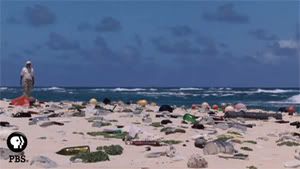
Trash on the Spin Cycle - PBS


image credit PBS


This is a short video featuring Jean-Michel Cousteau speaking about ocean debris and the Great Pacific Garbage patch. It's really sad, some of the things going on here.

Cousteau is in the Hawaiian Islands (That's right, this is in America, people. Not some far-off distant land), where literally tons of garbage wash up from our disposable lifestyle.

"About 80% of this debris comes from land; it makes its way into storm drains, then rivers, then travels down our watersheds into the ocean."

What's worse is that the islands are nesting grounds for many important seabird species. The adults often mistake tiny plastic particles for food and will consume them, filling their bellies with non-digestibles so that the birds will feel full and stop eating, but in reality will actually be starving themselves to death. When the chicks hatch, the parents feed the plastics to their young.

In the video you can see piles of bird bones surrounded by tiny plastic particles. Cousteau even flips over a dead bird, and you can see the plastic falling out of its rotted stomach.

"We need to do better than this," he says. "It is our problem, and it is our problem to solve."

Video here (PBS)
See recent post about the Atlantic Garbage Patch


***UPDATE***

DOH! I almost forgot!!
I wanted to link you to an awesome post I saw yesterday about what to do with all your plastic shopping bags you have hanging around. Check it out!
(Buy me that first new-bag made out of old-bags.)

Wednesday, 7 July 2010

Phytoplankton Bloom off Iceland - Earth Observatory

Check out this photo! Featuring one of my favourite types of all sea creatures...phytoplankton! Yes, I love my little algae.

Below the photo is a cool mini-article suggesting that perhaps the phytoplankton bloom begins in winter, as opposed to spring as most scientists have traditionally thought.

Full article/photo here (Earth Observatory)

Tuesday, 6 July 2010

The Latest on the Oil Spill - NY Times

Oi. It's hard to play catch-up after a holiday, but in the interest of my mental health I choose to take full advantage of my time off and not worry about a thing, so forgive me if I've missed a few details in the posts that follow. Anyway, here we go.

The National Oceanic and Atmospheric Administration (NOAA) predicts that the likelihood for oil to reach the Eastern coast of the United States is still small, using models based on historical wind and ocean current information. The Florida Keys, however, may not be so lucky. NOAA predicts a 61 - 80% chance that oil will reach the shores of the Keys, Miami and Ft. Lauderdale. Meanwhile in Texas, tar balls are being found on beaches on the Bolivar Peninsula and at Galveston Island.

Hurricane Alex has been hindering cleanup efforts, but several skimmers have been able to return to the area since Friday, although success results have been deemed inconclusive due to remaining foul weather.

BP is currently working with wildlife protection groups addressing a lawsuit alleging that sea turtles were being burned alive in controlled burn areas due to their inability to escape the slicks. A US Navy "airship" (read: blimp) is being sent out to the site to help monitor wildlife in the contaminated area and to track slick movement from air. This is actually pretty cool, despite how lame blimps are, because it can stay in the air for 12 hours - much longer than planes and helicopters.

BP's total cost spent on the response has officially surpasses $3 billion...and everyone's talking about how that's a big deal, but honestly I still think that's nothing compared to what it's going to cost the families and states affected - not to mention the toll on wildlife losses. This figure doesn't include the $20 billion fund set up for personal loss claims by citizens in the areas, however. But I don't know, I still thought it would have been more than that by now. BP has also begun to relax their control over what the media sees and does not see. Perhaps we'll be seeing more from the Southern shores? ...Or perhaps they're confident in their cover-up efforts.

Full articles here (NY Times)
NY Times is doing a day-by-day report; this is the most recent (day 76).

Tuesday, 22 June 2010

BP Oil Slick Now Threatens 60 Percent of America's Tidal Marshes - EnergyBoom

At least check out this map. I'm not gonna shrink it and post it because it makes a greater statement at the original size.

We already know the spill has affected the Northern Gulf Ecoregion - where most of the reports have been coming from - but now it is threatening an additional two regions. It's close to entering the Southern Gulf Ecoregion, and the South Florida/Bahaman Atlantic Ecoregion is next after that.

There is a link from this article to download the spill trajectory file for Google Earth, if you'd like to keep an eye on this.

Full article here (EnergyBoom)

Friday, 18 June 2010

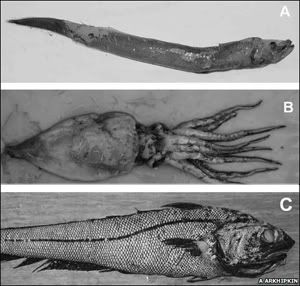
Deep Sea Fish 'Mystery Migration' Across Pacific Ocean - BBC

"Deep sea fish species found in the north Pacific Ocean have mysteriously been caught in the southwest Atlantic, on the other side of the world."


image source BBC via A. Arkhipkin


A giant rattail grenadier, a pelagic eelpout and a gonate squid have been found on the Patagonian Shelf off the Falkland Islands. No one knows just how they got there, but it is suspected that they were transported via deepwater currents.

"These flow south, across the equator, moving past South America underneath another northbound flow called the Humboldt Current. Finally, this flow mixes with another called the Upper Circumpolar Deep Water to pass through the Drake Passage, which separates South America and Antarctica, to the Southwest Atlantic."

Full article here (BBC)

Sunday, 13 June 2010

Oil to be Carried into the Atlantic?

We've been hearing about the possibilities, but how likely is it? If the oil continues to gush and spread - likely enough.

Here's a computer model using data from existing oceanic currents illustrating how the spill might possibly play out.

And here's what's actually happening.

Bad news. Bad, bad news.