Showing posts with label activists. Show all posts

Monday, 6 February 2012

The "S" Word

The "S" word has been in marine biology news a lot recently. We all cringe at the sound of this word. It calls to mind things like disease, poor health, stress, entanglements, pollutants, and a myriad of other causes we don't yet fully understand. It often means death.

The word is "strandings".
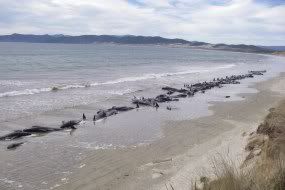

photo credit AAP & New Zealand Department of Conservation


Last month we heard of the 99 pilot whales stranded off Farewell Spit in New Zealand. This area is common for strandings and experts believe it is due to the relatively shallow waters in combination with tidal changes. It has been suggested that in areas like this, the sudden ascent of the bottom topography creates a situation where a whale's echolocation it uses to navigate will bounce around the area, confusing the animal and impairing navigation. Thirty-six whales died during stranding and the New Zealand Department of Conservation decided to put 33 whales down due to repeated re-strandings and significant stress and physical deterioration. Only seventeen whales from the pod were successfully refloated.

A stranding off Queensland, Australia this past summer didn't even get that happy of an ending. A baby humpback was separated from its mother and beached at Moreton Island. The calf was estimated to be only one to two weeks old and would have still been very dependent on its mother for food and protection. Speaking with a local expert on the matter, I found this stranding was particularly controversial - partly because of Sea World's involvement and partially due to the poor execution of the rescue attempts. As you may have seen in an earlier post, it is being debated whether Sea World always has the animal's best interest in mind during a stranding. My source suggested that an additional autopsy would have been beneficial to a certain Sea World vet when this calf stranded. Overall, the execution of the rescue efforts were questioned in that the whale was initially left on the beach while local authorities waited for Sea World responders, after which it was physically dragged back to sea - which would have been remarkably stressful for such a young animal. In the end the whale was euthanized after stranding a second time two days later.

Farther North in Lincolnshire, England another young whale was separated from its mother and stranded in the Humber estuary. Over 50 emergency workers worked for eight hours to dig a trench and successfully lead the whale back to sea where its mother had been spotted. The reunification of mother and calf is crucial in young whales, particularly those who are migrating as they may not yet know the area or direction to swim in.
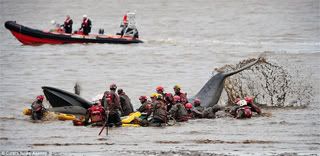

photo credit Caters News Agency


It is important for scientists to gather data during stranding events (or during autopsies in the case of failed rescues) so that we may come to understand why some of these events occur, how we can better respond and what we might be able to do to avoid them. Following the Deepwater Horizon spill in the Gulf of Mexico, hundreds of dolphins washed up dead or dying. One particular dolphin is being nursed back to health in Gulfport, Mississippi and is offering information into what caused the death of other dolphins in the area. The Institute for Marine Mammal Studies is currently not at liberty to reveal what exactly their findings have been, but they have said that finding a live dolphin was like "finding the black box from an airplane after a crash."

Recently another mass stranding has been in the news in Cape Cod, Massachusetts. Nearly 120 common dolphins have been stranding themselves since 12 January along the coast of Wellfleet. The hook of Cape Cod is another common area for cetacean strandings, much for the same reasons as Farewell Spit. Scientists are troubled by this stranding event because the number of animals involved in just these past few weeks is close to the total number of animals seen throughout the entire year. What's more is that all of the animals appear to be healthy. Despite this, over 80 dolphins have died. Some of the surviving individuals are being monitored by satellite tags to watch where they are going and how they are faring. Generally, the trend seems to be encouraging: the dolphins are swimming out into deeper waters and are not re-stranding. However, a large group of around 400 dolphins has been spotted off the Cape...It is unclear at this time whether they will head into the bay or continue their journey safely on the outside.
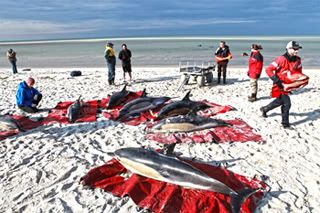

photo credit IFAW


So what should you do if you find a stranded cetacean? First of all, contact your local stranding network where experts will be able to instruct you further and make their way to the scene. If you don't know who your local stranding network is, contact animal control or the local police who will be able to help you get in touch with the correct people. If the animal is on it's back or side, and if you have someone to assist you, gently roll the animal onto it's stomach and try to keep it wet with sea water - careful not to get any water in it's blowhole. Minimize your contact with the animal and keep other people and dogs away. Listen to the experts' instructions and be careful. Whales are dolphins are wild animals and a stranded cetacean is in a stressful situation and can injure or transfer diseases to you.

Volunteers are continuing to work along the shores of Wellfleet to rescue the stranded dolphins. If you can, please consider donating to the International Fund for Animal Welfare (IFAW)'s critical need fund to help these animals.

More information at IFAW, who is leading the stranding response team.

Saturday, 14 January 2012

WDCS's Origami Dolphin Campaign

Hey guys,

As a follow-up to my last post about Morgan the orca, I thought it would be a great idea if we could get as many people as possible to join the Whale and Dolphin Conservation Society's campaign for a dolphinarium-free European Union.

So how do you get involved? Well it's fun and it will only cost you the price of a postage stamp!

Make an origami dolphin (or whale) and send it in to WDCS by the end of March to make a statement against captive dolphins in the EU.

Watch this instructional video to make your own little dolphin:


Your origami creations will be sent to the European Parliament from the people of the world as a petition in favor of free dolphins living their natural lives.

Here's mine!


Click here to be taken through to the campaign website.

Let's make sure this never happens to cetaceans like Morgan again.

Thanks for participating and speaking up for dolphin freedom!


***UPDATE***
Who likes prizes?
Trick question - everyone does.

Have you made your origami dolphin yet? Send me a photo of your little paper creations to be entered into a prize draw!

Don't forget: Your origami dolphins need to reach WDCS by the end of March to be included, so make sure you pop them in the mail soon! Photo submissions for the prize draw will end Friday 23 March (to ensure you have proper posting time!), winner will be selected randomly and announced on the 31st.

Photo entries will be posted on this blog. Don't forget to leave a way for me to contact you if you've won!

This prize draw is being conducted by the Unemployed Marine Biologist and is not directly affiliated with the Whale and Dolphin Conservation Society.


***ANOTHER UPDATE***
WDCS has extended their origami dolphin campaign until the end of September. That gives you lots of time to submit your little paper buddies! However, my prize draw will still be ending Friday 23 March, with the winner announced on 31 March.

With all this extra time, maybe I'll do another prize draw in September...?

I'm thinking of some prizes for this go around. Feel free to submit any ideas in the comments!

This prize draw is being conducted by the Unemployed Marine Biologist and is not directly affiliated with the Whale and Dolphin Conservation Society.

Wednesday, 11 January 2012

Morgan's Story


photo credit WDCS


A little girl is found lost and starving in an unfamiliar place. The people who find her take pity on her, and take her back to their home to look over her, nurse her back to health and try to find her family. Time passes and the little girl is doing great and is ready to go home, but the people who found her change their minds. They decide to sell her into a circus and lifelong slavery instead. She will never see her family again.

Is this story any less shocking because it's about a whale?

Killer whales, or orcas, are one of the most intelligent species in the world. They are known to mimic behaviors they have observed, problem solve, and even pass down skills to their young such as difficult hunting techniques. This is all in the wild – by the way. Unfortunately, this combined with their striking black and white appearance makes them very attractive to marine parks such as Sea World, which is famous for its captive orcas. Killer whales also have some of the most stable social structures in the animal kingdom, comparable only to elephants and primates (which include humans). Orcas in the wild have been known to stay with their matrilineal families for their entire lives, which can be up to 90 years. Because of these close familial bonds, marine mammal experts are concerned that keeping orcas in captivity is inherently inhumane. The average lifespan of an orca in captivity is eight years.

Morgan was found in June 2010 off the coast of the Netherlands – lost, starving and dehydrated. She was not stranded, she was swimming, and so she had to be captured by staff from the Dolfinarium in Harderwijk. This is the first sketchy point...when a dolphinarium sees a young female cetacean, they see dollar signs (Euro signs, I suppose in this case). The Harderwijk Dolfinarium has ties to the dolphin slaughter and trade in Taiji, Japan; and also to SeaWorld, owned by the Blackstone Group, which is invested in marine amusement parks across Europe and therefore has a considerable interest in the marine mammal trade.

Through this teamwork and a certain amount of comittee-forming, arguable research papers, and commercial interest...

"...By mid March 2010, all circuits were wired to ensure that any marine mammal that needed to be ‘rescued’ would be netted into this conglomerate power base. Although taking place in Europe, SeaWorld and other U.S. interests are deeply involved."

Que Morgan.

Morgan was captured and rescued under the conditions that she would not be displayed to the public and would be returned to the wild post-rehabilitation. Despite this, the Harderwijk Dolfinarium put her on display only two months after her arrival. The Free Morgan Group presented the argument to the dolphinarium that Morgan was an excellent candidate for release after rehabilitation in that she is young, has not been in captivity for a very long time and her native population had been traced. Morgan is believed to belong to the Norwegian fish-eating orca community based on DNA and call structures. Her release is more likely to succeed due to the fact that this population demonstrates communal care for young. She may, however, not be accepted by a pod which will mean she will not be looked after. Her young age may also mean that she does not know her family's full geographical range and therefore may not be able to find them. The Free Morgan Group has considered this, and has come up with a "soft-release" program in which Morgan would be able to gradually build up stamina and knowledge of her habitat by being systematically re-introduced to different aspects of the area over the course of time. This is similar to the program that Keiko – star of Free Willy – followed, which was partially successful. On Morgan's side is that she has not spent nearly as much time with humans as Keiko had. Another orca called Springer-Springer has been reintroduced using similar steps as well. She was found in a comparable state to Morgan, lost and emaciated. She was successfully nursed back to health in a sea pen and was reintegrated with a local pod which she still lives with today. Even if Morgan was not able to find her family, the case of Luna, a young male orca, demonstrates that stranded orcas can be released again and survive successfully on their own.

Despite this, Harderwijk Dolfinarium argued that Morgan was not eligible for release and made no attempts towards any rehabilitation steps. The Free Morgan Group's report was ignored and was not even mentioned in the dolphinarium’s reports.

Free Morgan Foundation - Morgans story from Fair Projects on Vimeo.


On 29 November 2011, Morgan was transferred to Loro Parque in Tenerife, despite a legal case against the Harderwijk Dolfinarium and against the advisement of many cetacean experts.

The case of Morgan is especially sad because it may set the tone for future rescued cetaceans. The captivity industry has come under fire recently after the death of Dawn Brancheau, a Sea World trainer killed by the orca Tilikum. The Morgan case shows that captive marine mammal facilities and business conglomerates still have a lot of power and are still reluctant to choose what's right over what's profitable.

From the Marine Connection "Free Morgan" website:

"Morgan does NOT belong in captivity. Born the wild, she doesn’t belong to a private company which sells tickets to see her – she belongs in the ocean. Anyone who cares about the future of this young animal and for all wild-born orcas should insist that Morgan be returned to her ocean home."


What can you do to help Morgan?

DON'T BUY A TICKET to Loro Parque or similar marine theme parks that have captive marine mammals.

EDUCATE YOURSELF on the current issues in marine mammal captivity.

SPREAD THE WORD about the fair treatment of animals and that taking wild creatures into captivity is inherently wrong.

JOIN THE CAMPAIGN TO MAKE SURE THIS NEVER HAPPENS AGAIN. Keep Morgan in mind and fight for the freedom of future cetacean rescue cases.

Wednesday, 14 September 2011

New Global Ocean Website and Ocean Awareness March

Well guys, it's here. Finally. See what I've been spending all my time doing recently and check out the new Global Ocean website! It's beautiful! (No, I didn't build or design it, just managed and wrote up a bunch of content. You can see all my blog posts here, and be sure to check out the Campaigns and Learning pages, 'cuz I worked on those too!)

And now that the website is live, I can link it up with a post I've been delaying until the launch. Earlier this summer I participated in an Ocean Awareness March through London organised by London Against Cetacean Slaughter. Check out my writeup below, or read it on the new Global Ocean site!


photo credit Maura Flynn; clickthrough for larger


On 31 July 2011 approximately 50 ocean activists from around the UK gathered in sunny London for the Ocean Awareness March, organised by London Against Cetacean Slaughter. The goal was simple: Raise awareness and call to the public about the plight of marine species worldwide.

The crowd had a positive mood and an important message – The seas must be saved if we are to save ourselves!

The parade marched across central London, through Trafalgar Square and past the Japanese and US embassies carrying signs with messages including "whaling is not culture," "save our seas" and "beep if you like dolphins."

Notable attendees included PADI EMEA vice president Mark Caney and whale activist, artist and Surfers for Cetaceans director Howie Cook. Several organisations also participated in the event including Global Ocean and Women for Whales as well as Sea Shepherd, who were raising money for their impounded flagship the Steve Irwin.

There was a good response from the people of London with many taking fliers and stopping to ask questions. We even had some folks waving, cheering and beeping their horns!

London Against Cetacean Slaughter is committed to putting an end to whaling and to dolphin drives like those in Taiji, Japan. For more information on London Against Cetacean Slaughter click here.


photo credit Maura Flynn

Tuesday, 6 September 2011

Japan Dolphins Day 2011


photo credit Save Japan Dolphins


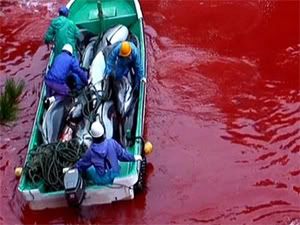
September 1st is the annual start of the dolphin drive in Taiji, Japan. If you've seen "The Cove" you know what this means. If not, let me (briefly) enlighten you.

Each year roughly 2,000 dolphins are frightened and chased by boats into two coves. One is the "capture" cove, the other is the "killing" cove. Of those 2,000 dolphins - which include the well-known and liked bottlenose dolphin, as well as striped dolphins, spotted dolphins, Risso's dolphins, pilot whales, false killer whales and plenty of other dolphins, small whales and porpoises - a handful of the most attractive are selected to be sold into dolphinariums and marine parks like SeaWorld and Six Flags...the rest are slaughtered for their meat, and for "pest control" under the belief that the dolphins are eating too much fish (dolphins eating too much fish...can you believe this?).

So what else happens on September 1st?

September 1st is also Japan Dolphin Day, a day of celebration of the lives and beauty of dolphins unharmed, in the wild as they should be. Japan Dolphin Day is a positive event. As Ric O'Barry himself noted on the SaveJapanDolphins website:

"It may be more effective to get people to be FOR something than AGAINST something. Some NGO's will not participate in a protest. So, our plan is to organize an international day of celebration in several cities around the world. The goal is to make this the biggest global event celebrating Japan dolphins yet."

And so we did. People around the world came together and demonstrated their concern over the annual slaughter at over 40 Japanese embassies and consulates. Participating cities included Washington D.C., Berlin, Melbourne, Rome, Auckland, Los Angeles, Amsterdam, Taiji, and of course...London! See below for some of our awesome photos (taken by yours truly; clickthrough for larger):


Well I had to include one of myself...I'm the dork with the "Beep if you like Dolphins" sign
photo credit Samuele Braccini


To see some of the other awesome photos from around the world, check out the Save Japan Dolphins Facebook album here.

The primary people working on the Save Japan Dolphin cause are Ric O'Barry, the Earth Island Institute and the Sea Shepherd Conservation Society. Check out their lovely sites for more information, and don't forget to watch "The Cove"!

More photos here:
Japan Dolphin Day; London - Demotix
Protests against Japan's Annual Dolphin Hunt - Yahoo! News
Dolphin Lovers Unite on Dolphin Day - Global Animal
Japan Dolphin Day Events Worldwide - Save Japan Dolphin Facebook album

More information here:
Save Japan Dolphins
Sea Shepherd Conservation Society

Saturday, 3 September 2011

Will this year's Whale Hunt go on?

Ugh.

So, I've been delaying my next update because I wanted to have it coincide with the launch of the new Global Ocean website, which I have been dedicating most of my time to recently. I've already written the entry there and it's beautiful and awesome, BUT...the site still isn't up. It was supposed to be up three weeks ago, but I got an email this morning saying the site content was lost. Not gone, not deleted...lost. So, it's out there on the internet somewhere. If you see it, let me know.

In the meantime...let's talk about whales. So much whale news!


photo credit Australian Customs Service


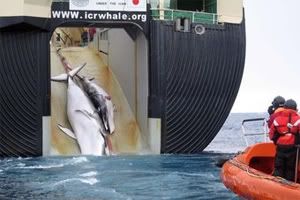
Whaling season has crept up on us again, and the tensions are running high in several countries, namely Japan. Earlier in July a meeting of the International Whaling Commission (IWC) to discuss a potential whale sanctuary in the Southern Ocean was delayed one year thanks to a walkout of those representing Japan & friends.

"Delegates from Japan, Iceland and a number of allied Caribbean and African nations walked out when the issue came up at the IWC's annual talks in Jersey, throwing the meeting into disarray. They later returned to the IWC floor but no agreement was reached on the issue, which was put on hold until next year's IWC meeting to be held in Panama."

Some good news from this meeting, however, is that the IWC has changed its membership fee policy to that of accepting only bank transfers, which are easily traced. This was due to concern that Japan has been buying smaller nation's memberships in return for their pro-whaling votes.

Japan has been adamant about continuing their whaling programs in the Antarctic despite its unpopularity worldwide. Guess who else has been adamant about returning to the Antarctic? Sea Shepherd. Oh yeah. That's right.

"Each successive year, Sea Shepherd has sent bigger fleets and faster vessels, while Japan has downscaled its forces; last season, for the first time, the activists had the upper hand."

Winning.
An interesting sidenote: "Some observers have suggested that Japan sees blaming Sea Shepherd as a way to escape from Southern Ocean whaling without losing face."

Hmmm...

Come August, however, change was in the air:

"A senior member of a government review panel set up to advise options after last summer's disastrous season has raised the stakes by openly calling for a halt. Respected Japanese consumer advocate Hisa Anan rejected any scientific need to kill whales.
'Research whaling has been conducted for more than 20 years now,' Ms Anan told the ABC through an interpreter in Tokyo. 'I think they've gathered enough scientific data and even if they want more, they can conduct non-lethal research.'"


The Fisheries Agency has even suggested the end of Japanese whaling, but a minority of the panel seems to agree.

A significant concern of the Japanese pro-whalers appears to be pride and saving face. The terms "giving up", "giving in" and "quitting" frequently come up on their side of the argument. It's common knowledge that the Japanese are a proud people - and for good reason too. Their discipline and schooling standards are well known throughout the world as top-notch, and their culture is one that is sensitive to and offended by outsiders trying to come in to tell them what to do. All understandable. However, most of the world seems to agree that the time for whaling has passed. The proportion of the Japanese population that actually consumes whale meat is small, and the financial burdens of supporting an expensive overseas industry with little return is worth mentioning.

Last year Japan went home with less than 1/5th of their total catch quota thanks to the Sea Shepherd crew. Some are arguing that it's too dangerous and simply not worthwhile to whale anymore, but others are just too proud to call it quits.


More information here:
Japan Walkout throws Whaling Talks into Disarray - TimesUnion.com
Whaling Body Outlaws Malpractice with Anti-Corruption Reform - The Guardian
Japan 'To Continue' Antarctic Whaling - BBC
Japanese Advocate calls for Halt to Whale Hunt - Sydney Morning Herald
Japan Considers Canning Whaling Program - ABC Australia

Wednesday, 3 August 2011

The 'Steve' is Free!


photo credit Sea Shepherd Conservation Society


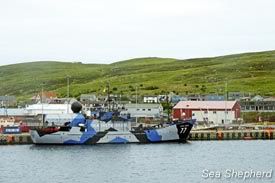
Great news from Lerwick - the Sea Shepherd's flagship vessel, Steve Irwin, has been freed! Thanks to all of the Sea Shepherd Conservation Society's supporters, they were able to raise more than $735,000 in under two weeks to post a bond to the British courts, freeing the ship from detainment...with one minute to spare! A court date has not yet been decided for the civil case brought by Fish & Fish Limited for the freeing of illegally caught tuna in Libya.

A message posted on the Sea Shepherd's website:

"We sincerely thank everyone that donated to help Save Our Ship. Your help enabled us to ‘Free the Steve’ and it will soon be on its way to the Faeroes. However, despite everyone’s best efforts, we had to cut into our already scarce budget to meet the bond amount and ‘Free the Steve.’ We face the ongoing costs of Operation Ferocious Isles, the transit of our vessels from the northern hemisphere to the southern for Operation Divine Wind, and finally, the cost of that Antarctic campaign as well. We are all on the same crew, despite our different roles and varying locations. We all feel that inner drive to protect innocent lives and ecosystems, and I know many of you have given what you can— but please keep your donations coming in. Without your help, we cannot continue this important work."

Full article here (Sea Shepherd Conservation Society)

Friday, 29 July 2011

Free the Steve!


photo credit Sea Shepherd Conservation Society


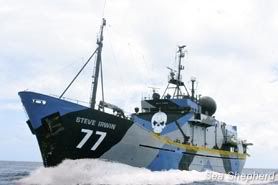
The Sea Shepherd's methods might be controversial, but one thing is for sure...They get shit done. Even the Japanese admitted it.

But the Sea Shepherd's flagship the Steve Irwin is in danger of being seized and sold. Right now, the British courts are holding the vessel in Lerwick, Scotland because of a civil lawsuit brought against Sea Shepherd for the release of (allegedly) illegally caught endangered bluefin tuna by Maltese fishing company Fish and Fish Limited. The bond demanded for the release of the ship is a whopping $1,411,692.87.

But you can help! I urge you to donate whatever you can to aid this fearless organisation's flagship and to help get it back out onto the seas in time to save the Faeroese pilot whales and the great whales of the Southern Ocean.

I understand times are tough right now and money is scarce for most. Believe me, I understand...this blog ain't called the UNEMPLOYED Marine Biologist for nothin'. However, I do make a little bit of money here and there, and recently I've been really bummed about the state of everything and I've been trying to figure out what makes me happy and what makes the world a better place. I reached two conclusions: 1.) Doing everything in my power to protect and raise awareness about marine conservation is what makes me happiest, regardless of money. 2.) I would be devastated if the Sea Shepherd lost their flagship vessel and wasn't able to protect our seas in that special kick-ass way they do. Also, I hate my fucking "job", so I gave all that misery-money from my check last week to a better cause: Supporting the direct action and conservation of the people at Sea Shepherd.

Whatever you can spare, I urge you to do the same. I promise you won't regret it!

Click here to read (and watch!) a personal message from Captain Paul Watson.

Tuesday, 19 July 2011

Saving Valentina

Please take a moment to enjoy this amazing video circulating on the net of Michael Fishbach's (co-founder of The Great Whale Conservancy) story of his close encounter and subsequent rescue of a young entangled humpback whale. Great work!!

Tuesday, 28 June 2011

Hands Across the Sand 2011 Summary

It's been a few days since the 25th when people around the world joined hands in unity against offshore oil drilling, and to be honest I needed to not think about it for a few days.

This year was decidedly less spectacular than last. No doubt the lack of an environmental disaster this spring meant people easily forgot that this was an annual event.

Three people showed up in London - far less than I was expecting given the amount of effort I put into promoting it, the early press we got and the promises from other people saying they would be there. Was I disappointed? Well, yes. How could I not be? But do I regret doing it? Absolutely not. I did my best, and I would regret it more if no one did anything this year in London.

Forty US states and eighteen countries participated this year - a noticeable drop from last year following the Deepwater Horizon spill in the Gulf of Mexico. But the cause is still strong. This year in London we talked about what had been done since the spill, and what new information had come out. It's difficult because we're still researching, measuring and analyzing the effects of the spill and we don't really have a good understanding of the environmental implications just yet. We also discussed BP's shady tactics of buying out a number of researchers in the Gulf last summer...We won't be hearing from them for several years still.

I'd like to think this is a lull in the feelings of the people while we are still sorting out this mess, and when new information revealing the true amount of damage is brought forward, there will be more people with outreached hands drawing lines in the sand.

On a personal note, this was the first environmental event I've planned entirely by myself, and it was harder than I expected. Lessons were learned and I have some experience and ideas for the next event...which I'll be mentioning soon!

I'll leave you with our tiny but happy Hands Across the Sand demonstration this year in St James's Park, London:

Friday, 24 June 2011

Hands Across the Sand 2011 Final Call

LAST CHANCE!

TOMORROW Hands Across the Sand comes to a beach (or public area) near YOU. JOIN HANDS if you think it's time to say NO to offshore oil drilling & dirty fossil fuels and YES to clean energy & a sustainable future!

Join me in London at noon and give 15 minutes of your weekend to the planet we all call home.

Find us on:
Hands Across the Sand
Facebook
Gumtree
Craigslist
Twitter
Global Ocean

Hope to see you there!

Friday, 17 June 2011

Hands Across the Sand 2011 Update


image credit Hands Across the Sand


Your local Hands Across the Sand event is happening a week from tomorrow! Get excited!!! (I know I am.)

To find your local event, check the map at the official Hands Across the Sand website, or register your own if there's not one close by! It's not too late!!

If you happen to be in the London area, come on down and join me at St James's Park for a fun, fast & free way to help save the environment and move towards a cleaner energy future. Check us out on Facebook, Gumtree or the official Hands Across the Sand site under "Global Locations". I promise it will be a good time!

Rain or shine, folks. No harm in getting a little wet while protecting our seas.

All welcome. Even YOU. :)

*ahem*
And now, I am please to bring to your attention, a lovely article which contains an interview about our event this year. I'm very happy people are taking notice of this! Click below!

Digital Journal via Alexander Baron, Op-Ed: Hands Across the Sand - To Save the Planet

I'd also like to thank London Against Cetacean Slaughter and Global Ocean for helping to promote this event. Keep fighting the good fight, guys!

Thursday, 12 May 2011

A Birthday Wish

Hey everyone,

My birthday is on Monday and I'm trying to raise $100 for the Fund for Gulf Coast Restoration. If you love marine biology, the beach, or the environment (or me!) and you're feeling generous, please consider making a small donation to this cause!

Click here! Thank you!! :)


photo credit Cathy Hennessy


***UPDATE***
Thank you to all my friends who helped me reach my goal of $100 for the Fund for Gulf Coast Restoration!! Couldn't have done it without you!

Monday, 14 February 2011

A Special Valentine's Message!

Hey all!

Happy Valentine's Day! Spread the love, but don't forget to love our oceans!!


<3

Wednesday, 9 February 2011

Sharks in Chinatown

Hi all.

The demonstration last Thursday in Chinatown was a great success!


photo credit EcoHustler


I was excited before I even got there. I had read an article the day before we even went over about restaurants that were already pulling shark fin soup from their menus, fearing the bad PR it would bring them.

"'We’ve taken it off the menu,' says Yip-Cheong Wong, manager at the Golden Dragon, pointing to a sticker plastered across the soup section: 'Save the shark: This item is no longer available.'"

And other restaurants have followed suit, how exciting!

Personally, I was a bit worried about going into a cultural center on a big holiday and offending people who value their traditions. I've mentioned here before I don't think aggressive confrontation is always the best way about things. However, I did like the way the EcoHustler blog put it:

"The trouble is, eating shark fin is a cultural phenomenon so you have two choices: be politically correct and look the other way or strap a pair on and have a conversation with the people who like to eat it."

The people of Chinatown seemed genuinely concerned about the shark populations and many of them were very opposed to shark fin soup and the practice of shark finning. It was a very friendly afternoon and we reached a lot of people.

So what did we do?

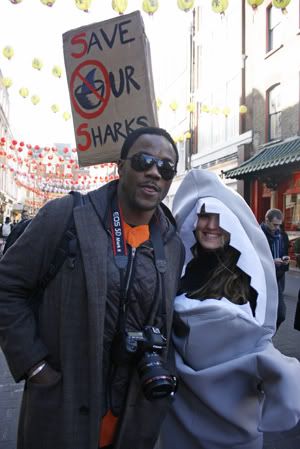
Well, Matt over at EcoHustler created some nice leaflets (available for download and distribution) for the event with information about the decline of shark populations and a few suggestions for people to take action. Having never handed out leaflets before, I was honestly surprised at how many people took and read them. I always just assumed that no one ever took those things, ha! We also had a lovely shark-person in participation:


photo credit EcoHustler


And shark cookies!


om nom nom
photos are my own


We teamed up with Global Ocean, who is preparing a petition to end shark finning in the European Union. Please take a moment to sign it here. There is only one week left before it must be delivered!!

Conversations worth mentioning were with a restaurateur who owns a chain of Chinese restaurants and was concerned about the image shark fin soup gives establishments who continue to sell it, and a woman raised in China who has known shark fin soup all her life but remains shocked and horrified at the practice of finning and doesn't understand why anyone actually supports it.

All in all, a great day with great people.

Missed the event? No worries. Stay tuned here for future rallies and things you can do on your own. Why not start by refusing to buy from restaurants who continue to serve shark on the menu, and by signing the Global Ocean petition?


Additional Information:
Shark’s Fin Comes Off Menu as Cruelty Campaign Sways U.K. Chefs - Bloomberg
(*Worth noting in this article, Royal China claims to have removed all shark products from their restaurants, but investigation by EcoHustler proves otherwise. It is important to note that many of these restaurants will serve it off the menu as to not attract negative attention)
EcoHustler
Check out EcoHustler's summary of the event here; "We Joined the SharkSide!"
Save Our Sharks leaflets for download
Global Ocean
Global Ocean's petition to ban shark finning in the European Union

Sunday, 30 January 2011

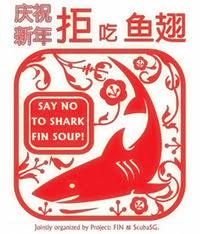
Say No to Shark Fin Soup on Chinese New Year


photo credit Shawn Heinrichs


Chinese New Year is Thursday, and celebrations will be happening all week long. While I'm all for dancing dragons, beautiful paper lanterns, fireworks and a shit-ton of rice, one Chinese tradition I will not be enjoying is shark fin soup.

Shark fin soup has been described as "bland" and "gelatinous." Not exactly something appealing. Yet, as a status symbol, it has been gaining popularity for quite some time as the middle class economy in China has grown.

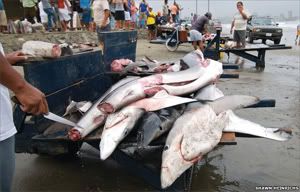
The practice of finning is gruesome and wasteful beyond a doubt. Live sharks of every species are caught and their fins are cut off while the animals are still alive. Only the fins are saved - the rest of the shark is thrown back into the sea. Unable to swim with their fins now removed, the sharks sink to the bottom and die a slow death, often eaten alive by scavengers or smaller fish. Additionally, many shark species need to swim in order to push oxygenated water over their gills to breathe. Without the ability to swim, the sharks slowly suffocate on the ocean floor.

It was recently announced by the Pew Environment Group and a wildlife trade monitoring network called Traffic that the ten-year shark conservation plan set by shark fishing nations has failed. Agreed upon in 2001, recommendations included "identifying and protecting key habitat, ensuring catches are sustainable, and minimising waste and discards."

Of the top 20 shark fishing nations - which account for 80% of the worldwide catch (~100 million animals per year) - only 13 currently have national plans outlined.

"'The fate of the world's sharks is in the hands of the top 20 shark catchers, most of which have failed to demonstrate what, if anything, they are doing to save these imperiled species,' said Glenn Sant, leader of Traffic's global marine programme."

Due to the increase in negative publicity, and the knowledge spreading that shark fin soup is no longer a sustainable dish, many restaurants have been taking positive measures and removing it from their menus.

Says Bernard Ng, Imperial City restaurant manager in London: "Times are changing and this once popular dish has become less fashionable in recent years...I think it's a positive decision that sets us apart from other Chinese restaurants."

But what can you and I do about it?

Well, for starters, don't buy shark fin soup! Don't ask for it, don't order it, don't go to restaurants and events that offer it...Reduce the demand! You are in control of what you support, so make a conscious effort not to support this unsustainable dish.

If you're on Facebook, I highly recommend looking up The Global Shark Initiative. They're a great organisation that offers lots of information and opportunities to take action on behalf of sharks - simple things we all can do to make a difference, like writing letters or sharing information via links. Save our Sharks from a Bowl of Soup is a similar group.

If you happen to be in London, let's go on a date! There will be a gathering of awesome environmentally-minded people in Chinatown this week, organised by EcoHustler:

"On Thursday 03 February people from many walks of life will come together in London’s Chinatown to celebrate the arrival of the Chinese New Year, and also to show their support for local efforts to take shark fin off the menu. The global trade in shark fin is pushing these ancient and awesome creatures to the brink of extinction. Sharks are apex predators, so when they are taken out, ecosystems are pushed out of balance with devastating knock-on effects. It is estimated by scientists that 90% of the global shark population has already been wiped out.

Sales of shark fin traditionally reach their peak at Chinese New Year. By visiting Chinatown on that day with flyers detailing the extent of the problem, with a positive message sustainability, we hope to change attitudes for the better, and persuade consumers to change their dining habits to protect our oceans.

You are invited to join this loose alliance of marine conservation groups, environmentalists, scientists, students and other concerned citizens to make a stand for sharks."


The more, the merrier. :)


image credit The Global Shark Initiative & Din


More information:
Shark Nations Failing on Conservation Pledges - BBC
Shark Fin Soup off Menu at Chinese Restaurants - The Evening Standard
The Global Shark Initiative - Facebook
Save our Sharks from a Bowl of Soup - Facebook
More on EcoHustler's London Gathering

Sunday, 24 October 2010

Flash Mob Descends on Causeway Bay Times Square - CNN


photo credit Pictures by the Wayside


Why? To raise awareness about the exploitation of sharks for shark fin soup!

Demand for the well-known Asian dish has been putting an enormous amount of pressure on sharks of all kinds - especially recently with population numbers lower than ever.

You can catch up on what exactly shark finning is here.

Recently a lot of public attention has been brought to the cruelty and wastefulness of shark finning, making the dish less and less popular in the public eye.

Check out the video from the Hong Kong flash mob in the link. It raises awareness while delivering a healthy dose of frozen people, shark costumes and butt-pinching.

Full article here (CNN)

Sunday, 3 October 2010

Dolphin ‘Massacre’ Protested - Copenhagen Post


photo credit Copenhagen Post


The Danish Faroe Islands are home to an ancient cultural ritual where pilot whales (actually dolphins) are chased from the sea and gutted on the shores. It used to be that the meat was needed to feed the small civilization, but today the bloody and disemboweled corpses lay lifeless on the beach for nothing but "cultural pride."

Friday in Paris, France in front of the Danish Embassy, dozens of protesters gathered to demonstrate their disapproval.

"The annual hunt is renowned as a bloody spectacle in which scores of whales are driven towards shallow water where they become beached and slaughtered."

Additionally, a letter is being sent to Queen Margrethe urging that the hunt be stopped.

Full article here (Copenhagen Post)

Kate Walsh’s Gaga-Inspired Sustainable Sushi Dress Auctioned Off For Oceana - Ecorazzi


photo credit NBC & Ecorazzi


Whut? Mmmkay, moment I wish I had a TV.

So I just heard about this sushi dress Kate Walsh wore on Leno. Inspired by Lady Gaga's disgusting-yet-creative meat dress, Kate Walsh decided to create a sushi dress. Worth pointing out - this was all fake sushi. No real fish on this dress, a wise choice if you ask me.

The dress featured only sustainable fish types and was designed to help raise awareness about choosing sustainable seafood. It is now being passed on to a fan as part of a sweepstakes for Oceana.

What do you think? Crazy idea or great way to raise awareness? Or both? Personally, I think this would make a great Halloween costume!

Full article here (Ecorazzi)
PS- Check out the latest sustainable seafood guide linked in this article! It offers sustainable suggestions based on the type of flavour and texture you already like in fish. (National Smart Seafood Guide produced by Food & Water Watch)

Friday, 1 October 2010

Ten Things Kids Want Us to Know About Trash in the Ocean - Ocean Conservancy


image credit Isiah & Ocean Conservancy


"I was heartbroken. Pollution is ruining the beauty of beaches around the world," says Jocelyn, a fourth-grader who participated in New York City's leg of the Ocean Conservancy's International Coastal Cleanup.

Students headed to their local beaches to collect garbage and record the items they found. Here's a bit of what they had to say:

"Some things that are making all these things go on beaches are that people throw things into lakes, rivers and oceans, and those things travel around the world and end up on shores and on beaches." -Juliet

"On Plumb Beach I saw two cigarette liters. You might think that's not so bad but they still had oil in them." -Karin

"I don't want to sound like I'm bossing people around but you guys have got to step up and get tough about this stuff." -Jack


The children sent in their findings to the Ocean Conservancy along with a few suggestions they had about reducing the amount of trash that ends up on our beaches.

Completely adorable. If fourth-graders can go out and actually do something about the problem, why can't adults?

Full article here (Ocean Conservancy)