Wednesday, 2 November 2011

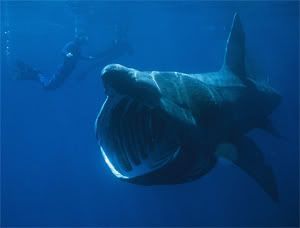
Brilliant Basking Sharks


photo credit Chris Gotschalk


Recently I was lucky enough to be able to attend a monthly meeting of the Marine Conservation Society (MCS) UK South East branch in London. The speaker of the evening was Evan Landy, an M.Sc. researcher from the University of Exeter, and the topic was basking sharks.

I've long been fascinated by these huge, ancient-looking fish. They are the second largest fish alive (after the whale shark), reaching 30 - 40 feet and weighing on average just over 5 tons. Despite this, basking sharks feed on some of the tiniest creatures in the ocean, passively filter-feeding delicious copepods from the sea surface as they lazily swim by. Despite their somewhat scary appearance, they pose no threat to humans and are a popular dive attraction.

Aside from learning when and where to go visit these amazing sharks (and that they're so big you can actually see them from shore!), I learned that we actually have something in common - the sharks and I. Landy's research has been on mapping populations and distributions of basking sharks around the United Kingdom, and it turns out they just happen to like warm sunny beaches and nice weather. What a coincidence. We should hang out some time.

Landy mentioned spotting sharks the past few years has been a challenge possibly due to the less-than-fantastic summers in the British Isles recently. MCS is looking for the public to report their sightings of basking sharks (and other creatures) on their website to help map where the animals are spending their time. Future work with this species will be aimed at training fishermen to report their sightings while at sea, satellite tagging and genetics.

For more information on the work of MCS, visit their website. Meetings of the South East branch are held on the second Tuesday of each month from 8:00 - 10:00pm, in the function room at the Holland Club, Imperial College, Kensington, London, SW7.

Thursday, 20 October 2011

There are better ways to see whales and dolphins...


Don't buy a ticket to a marine park!
See these beautiful animals in their natural habitats instead.
To find a whale watching trip in your area, click here!

Saturday, 15 October 2011

Britain's Special Guests

Two exciting sightings recently in UK waters:

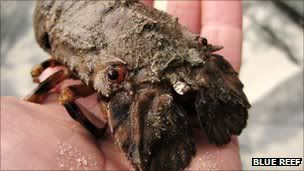
Last month a slipper lobster was found sitting atop a commercial crab pot east of Falmouth. This warm water species has only been recorded in Britain a few times since records began over 250 years ago. The lobster, named Popeye, is just under 5 inches long, has orange eyes and special plates on it's head used for burrowing in search of food or shelter from predators. Personally, I think Popeye is adorable.


photo credit Blue Reef


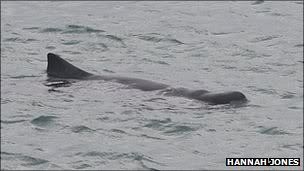
This month, another warm water species not previously recorded in the UK has joined Popeye in Cornwall. A dwarf sperm whale was spotted on a beach, raising the number of cetacean species sighted in UK and Irish waters to 29. The small whale, which scientists know very little about, was rescued by a member of the public and seems to have swum happily away.

Dr Peter Evans, Director of Sea Watch, said "Pictures of the Penzance whale show it to be dwarf sperm whale, its fin being large and almost triangular. This species has been recorded on only a handful of occasions in Europe, including Spain and France, and never in Britain or Ireland. It is just one of the increasing number of records of warm water species to be turning up around the British Isles in recent years."

Thanks to the unnamed hero who refloated the whale!


photo credit Hannah Jones


Read more about the slipper lobster on BBC here.
Read more about the dwarf sperm whale on BBC here.

Wednesday, 5 October 2011

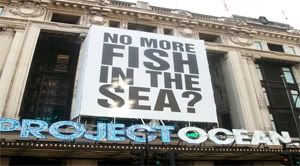
Selfridges' Project Ocean


photo credit Stephanie Dickens


Earlier this summer, Selfridges & Co launched its Project Ocean campaign, focusing on the threats of overfishing and poor fishing practices in the UK and worldwide. Partnering with over 20 environmental groups, Selfridges put together talks, activities, learning opportunities, workshops, information and their famous store-front windows to help raise awareness about the threats the ocean is currently facing.
Here's some lovely numbers:
-Nearly 4 million people saw Project Ocean’s windows
-Over 8 million Britons saw the Project Ocean campaign advertising
-45,000 Selfridges Fish Guides were given away
-More than 17,500 customers took part in an Ultralounge talk or activity, with an average of 700 people each day
-550 people attended the 4 Ocean Talks
-Coley Fish and chips in HIX
[Selfridges' restaurant and champagne bar] became the number one selling dish on its menu

Selfridges has also raised over £120,200.00 for the Zoological Society of London (ZSL) to create marine reserves. One area has already been set aside in the Philippines for the protection of fish and other marine life. They're still accepting donations, so if you're feeling generous today and want to be part of a new marine protected area, click here (and after you've sent your donation, click here to see your name on a fish)!

Four talks were held on the subjects of sustainable fishing and marine conservation. The first was called "Fishing in Troubled Waters" and was chaired by End of The Line author Charles Clover, with guests Nigel Edwards of Seachill and Iceland Group, fashion designer Katherine Hamnett, Jeremy Percy of National Under Ten Metre Fisherman's Association (NUFTA) and Hugh Fearnley-Whittingstall of Channel 4 and Hugh's Fish Fight.

Some highlights of this talk included Clover's statistics: 32% of the world's fish stocks are currently exploited, 85% are at or beyond their limits, and that the human population will rise 1/3 by 2050. It doesn't take a genius to put these pieces together. With a disproportionate amount of the human population relying on the sea for their main sources of food and protein, we are on a collision course with reality if we continue to fish the way we have been fishing.

One particular clip shown by Fearnley-Whittingstall illustrated the complications of fishing laws and waste catch. Fearnley-Whittingstall was filmed on a fishing boat when the haul was brought on board and sorted. Only a few individual fish were kept because they were the allowed and targeted species - the only species that by law the fishermen were allowed to keep. Twenty baskets of bycatch - more than the number of targeted species caught - had to be thrown overboard as waste. The fishermen had never seen it laid out before them like this and were visibly upset - one even lifting up a now-dead "waste" fish and saying that it was a beautiful specimen, one that would be hard to find nowadays, and it is being wasted for nothing. The bycatch caught on this one trip would have fed 2,000 people. It's not always the fishermen's fault that these species die and go to waste; sometimes the laws just aren't up to par.

There is hope, though. Sustainable fisheries and buying fish from healthy stocks is coming to the world's attention slowly but surely. Talks are being held in government buildings in many nations, but the truth is that there is still a long way to go.

But you can help. Change in a consumer market needs to come from the consumers.
◦There are many fish guide apps now available to help consumers be more informed on restaurant and shopping trips. Ask where and how your fish is caught (You'll likely be met with confused looks, but let your providers know you care! They will respond!).
◦Don't buy red-listed fish - if we only support fish from sustainable sources, the market will have to adjust to reap its profits.
◦Spread out your species - did you know that there are over 50 different species of tuna? Why not try skipjack instead of bluefin? Have you tried mackerel? Sprats?
◦Don't eat at restaurants that serve red-listed fish species, and let them know you're not impressed by their "fancy" selection.
◦Spread the word!

Stephanie at Global Ocean was lucky enough to attend all four of these talks. If you'd like their summary, please click through to her write-up!
Wednesday, 14 September 2011

New Global Ocean Website and Ocean Awareness March

Well guys, it's here. Finally. See what I've been spending all my time doing recently and check out the new Global Ocean website! It's beautiful! (No, I didn't build or design it, just managed and wrote up a bunch of content. You can see all my blog posts here, and be sure to check out the Campaigns and Learning pages, 'cuz I worked on those too!)

And now that the website is live, I can link it up with a post I've been delaying until the launch. Earlier this summer I participated in an Ocean Awareness March through London organised by London Against Cetacean Slaughter. Check out my writeup below, or read it on the new Global Ocean site!


photo credit Maura Flynn; clickthrough for larger


On 31 July 2011 approximately 50 ocean activists from around the UK gathered in sunny London for the Ocean Awareness March, organised by London Against Cetacean Slaughter. The goal was simple: Raise awareness and call to the public about the plight of marine species worldwide.

The crowd had a positive mood and an important message – The seas must be saved if we are to save ourselves!

The parade marched across central London, through Trafalgar Square and past the Japanese and US embassies carrying signs with messages including "whaling is not culture," "save our seas" and "beep if you like dolphins."

Notable attendees included PADI EMEA vice president Mark Caney and whale activist, artist and Surfers for Cetaceans director Howie Cook. Several organisations also participated in the event including Global Ocean and Women for Whales as well as Sea Shepherd, who were raising money for their impounded flagship the Steve Irwin.

There was a good response from the people of London with many taking fliers and stopping to ask questions. We even had some folks waving, cheering and beeping their horns!

London Against Cetacean Slaughter is committed to putting an end to whaling and to dolphin drives like those in Taiji, Japan. For more information on London Against Cetacean Slaughter click here.


photo credit Maura Flynn

Tuesday, 6 September 2011

Japan Dolphins Day 2011


photo credit Save Japan Dolphins


September 1st is the annual start of the dolphin drive in Taiji, Japan. If you've seen "The Cove" you know what this means. If not, let me (briefly) enlighten you.

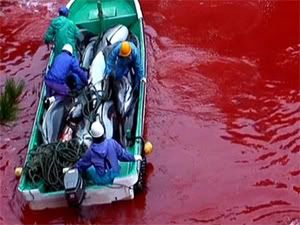
Each year roughly 2,000 dolphins are frightened and chased by boats into two coves. One is the "capture" cove, the other is the "killing" cove. Of those 2,000 dolphins - which include the well-known and liked bottlenose dolphin, as well as striped dolphins, spotted dolphins, Risso's dolphins, pilot whales, false killer whales and plenty of other dolphins, small whales and porpoises - a handful of the most attractive are selected to be sold into dolphinariums and marine parks like SeaWorld and Six Flags...the rest are slaughtered for their meat, and for "pest control" under the belief that the dolphins are eating too much fish (dolphins eating too much fish...can you believe this?).

So what else happens on September 1st?

September 1st is also Japan Dolphin Day, a day of celebration of the lives and beauty of dolphins unharmed, in the wild as they should be. Japan Dolphin Day is a positive event. As Ric O'Barry himself noted on the SaveJapanDolphins website:

"It may be more effective to get people to be FOR something than AGAINST something. Some NGO's will not participate in a protest. So, our plan is to organize an international day of celebration in several cities around the world. The goal is to make this the biggest global event celebrating Japan dolphins yet."

And so we did. People around the world came together and demonstrated their concern over the annual slaughter at over 40 Japanese embassies and consulates. Participating cities included Washington D.C., Berlin, Melbourne, Rome, Auckland, Los Angeles, Amsterdam, Taiji, and of course...London! See below for some of our awesome photos (taken by yours truly; clickthrough for larger):


Well I had to include one of myself...I'm the dork with the "Beep if you like Dolphins" sign
photo credit Samuele Braccini


To see some of the other awesome photos from around the world, check out the Save Japan Dolphins Facebook album here.

The primary people working on the Save Japan Dolphin cause are Ric O'Barry, the Earth Island Institute and the Sea Shepherd Conservation Society. Check out their lovely sites for more information, and don't forget to watch "The Cove"!

More photos here:
Japan Dolphin Day; London - Demotix
Protests against Japan's Annual Dolphin Hunt - Yahoo! News
Dolphin Lovers Unite on Dolphin Day - Global Animal
Japan Dolphin Day Events Worldwide - Save Japan Dolphin Facebook album

More information here:
Save Japan Dolphins
Sea Shepherd Conservation Society

Saturday, 3 September 2011

Will this year's Whale Hunt go on?

Ugh.

So, I've been delaying my next update because I wanted to have it coincide with the launch of the new Global Ocean website, which I have been dedicating most of my time to recently. I've already written the entry there and it's beautiful and awesome, BUT...the site still isn't up. It was supposed to be up three weeks ago, but I got an email this morning saying the site content was lost. Not gone, not deleted...lost. So, it's out there on the internet somewhere. If you see it, let me know.

In the meantime...let's talk about whales. So much whale news!


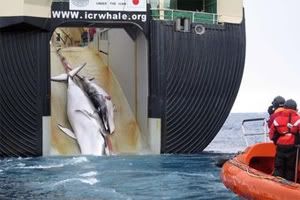
photo credit Australian Customs Service


Whaling season has crept up on us again, and the tensions are running high in several countries, namely Japan. Earlier in July a meeting of the International Whaling Commission (IWC) to discuss a potential whale sanctuary in the Southern Ocean was delayed one year thanks to a walkout of those representing Japan & friends.

"Delegates from Japan, Iceland and a number of allied Caribbean and African nations walked out when the issue came up at the IWC's annual talks in Jersey, throwing the meeting into disarray. They later returned to the IWC floor but no agreement was reached on the issue, which was put on hold until next year's IWC meeting to be held in Panama."

Some good news from this meeting, however, is that the IWC has changed its membership fee policy to that of accepting only bank transfers, which are easily traced. This was due to concern that Japan has been buying smaller nation's memberships in return for their pro-whaling votes.

Japan has been adamant about continuing their whaling programs in the Antarctic despite its unpopularity worldwide. Guess who else has been adamant about returning to the Antarctic? Sea Shepherd. Oh yeah. That's right.

"Each successive year, Sea Shepherd has sent bigger fleets and faster vessels, while Japan has downscaled its forces; last season, for the first time, the activists had the upper hand."

Winning.
An interesting sidenote: "Some observers have suggested that Japan sees blaming Sea Shepherd as a way to escape from Southern Ocean whaling without losing face."

Hmmm...

Come August, however, change was in the air:

"A senior member of a government review panel set up to advise options after last summer's disastrous season has raised the stakes by openly calling for a halt. Respected Japanese consumer advocate Hisa Anan rejected any scientific need to kill whales.
'Research whaling has been conducted for more than 20 years now,' Ms Anan told the ABC through an interpreter in Tokyo. 'I think they've gathered enough scientific data and even if they want more, they can conduct non-lethal research.'"


The Fisheries Agency has even suggested the end of Japanese whaling, but a minority of the panel seems to agree.

A significant concern of the Japanese pro-whalers appears to be pride and saving face. The terms "giving up", "giving in" and "quitting" frequently come up on their side of the argument. It's common knowledge that the Japanese are a proud people - and for good reason too. Their discipline and schooling standards are well known throughout the world as top-notch, and their culture is one that is sensitive to and offended by outsiders trying to come in to tell them what to do. All understandable. However, most of the world seems to agree that the time for whaling has passed. The proportion of the Japanese population that actually consumes whale meat is small, and the financial burdens of supporting an expensive overseas industry with little return is worth mentioning.

Last year Japan went home with less than 1/5th of their total catch quota thanks to the Sea Shepherd crew. Some are arguing that it's too dangerous and simply not worthwhile to whale anymore, but others are just too proud to call it quits.


More information here:
Japan Walkout throws Whaling Talks into Disarray - TimesUnion.com
Whaling Body Outlaws Malpractice with Anti-Corruption Reform - The Guardian
Japan 'To Continue' Antarctic Whaling - BBC
Japanese Advocate calls for Halt to Whale Hunt - Sydney Morning Herald
Japan Considers Canning Whaling Program - ABC Australia